
The 1994 Forestry law and its degree of applications specified in Section 3, that the management of permanent forest (including national parks, wildlife sanctuaries, production forests, forest reserves etc.) refers to the carrying out of certain activities and investments, based on previously established objectives and on a plan, for the sustained production of forest products and services, without affecting the primitive value or compromising the future productivity of the forest.
Despite the legal forestry stipulations, permanent forest estates (Forest Management Units, Council Forests, Forest Reserves and National parks) in the South West Region of Cameroon face a host of challenges that threatened the biodiversity wealth of these forest estates. These include poor governance, illegal logging, encroachment for agriculture, poaching and unsustainable management of natural resources.
To promote the sustainable management of production forests in the South West Region, the Regional Delegation of Forestry and Wildlife within the framework of PSMNR-SWR is working to:
Ensure responsible and sustainable management of production forests according to valid management plans:
There are 05 active Forest Management Units (FMUs 11-001, 11-002, 11-003/4, 11-005 and 11-006) also called forest concessions in the SWR which are under a regime of industrial logging. They are part of the permanent forest estate that have to be sustainably managed according to a management plan. PSMNR-SWR is supporting MINFOF to carry out technical monitoring and follow-up of the management plan prescriptions of these FMUs in collaboration with the logging companies in order to ensure a stronger involvement of the local population in the management of FMUs and to create an enabling environment for their sustainable management and certification. The main objective of technical monitoring is to monitor ongoing management and exploitation practices thus proposing where possible alternatives/measures which will enhance the sustainable management of FMUs.
Promote the participation of local populations in the sustainable management of forestry and wildlife resources through the creation of community and council forests:
Sustainable management of natural resources for livelihood improvement especially for the poor sector of the population has been the overriding principle guiding the intervention of PSMNR-SWR. In the Program community development package, the establishment and management of community and council forests is foreseen as a sustainable source of funding to enhance and finance priority development projects. Community and councils forests are seen as means for the local communities to better control and benefit more from their natural resources. In this respect, PSMNR-SWR is currently supporting more than 11 community forests in the region. The Program is also providing technical, financial and institutional support in the challenging process of gazetting and managing the Nguti and Mundemba Council Forests.
Promote good governance:
The Forest Law Enforcement, Governance and Trade (FLEGT) Voluntary Partnership Agreement (VPA) was signed between Cameroon and European Union (EU) in October 2010. Enacted and ratified in 2011, VPA/FLEGT aims to improve forest governance, guarantee that the woods imported to the EU are from legal sources, promote the image of Cameroon timber and improve the competitiveness of the country on international markets. Taking into consideration the fact that Cameroon is committed to implement VPA/FLEGT for both export and domestic markets, PSMNR-SWR through MINFOF SW is making provisions to assist, empower, capacitate and accompany all forest stakeholders in the region in FLEGT and certification issues regardless of FMUs, community, council, communal or industrial forest management.
Develop and constantly update monitoring tools:
The Geographic Information System (GIS) database and the exploitation database of the South West Region developed by MINFOF within the framework of PSMNR-SWR are important monitoring tools which are regularly updated and used for management decisions.
So far only FMU 11005 is certified FSC and former certified FSC FMU 11001 is now attributed to SEFECCAM after the liquidation of TRC in September 2012. Furthermore, FMUs 11002, 1003/4 and 11006 are working towards OLB certification.
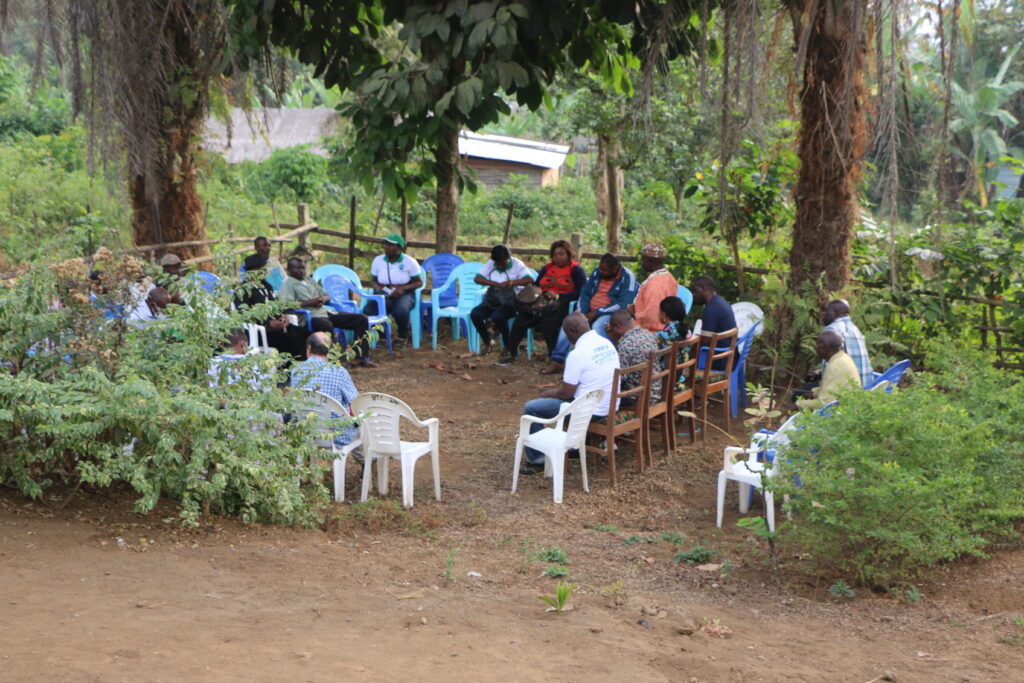
Although MINFOF-SWR (Regional Delegation, Divisional Delegations and Forestry Posts) is providing technical assistance to all community forests in the region, PSMNR-SWR is currently providing technical and financial support to 11 community forests out of 19 within the region. They include Akwen, Bakingili, Bakebe, Christian Philantropic, Etinte, MBACOF, Mosongiseli, NLORMAC, REPACIG, Tinto and Woteva community forests. These community forests have the potential to foster economic development in enclave rural areas and to create new employment opportunities since they are sources of legal timber for the Internal Wood Market. They are also foreseen as a sustainable source of funding to finance priority community development projects at village level.
Most of these community forests have signed Memorandum of Understanding (MoU) for collaboration with the PSMNR-SWR and elaborated joint Annual Operational Plan which are been implemented. The following activities have been implemented:
With the support of the program the Nguti Council Forest (11,919 ha) is in the process of being classified (the classification file was forwarded to the PM’s office in April 2009 and its draft management plan had been prepared in December 2008). A second council forest, Mundemba Council Forest (36,210 ha) is in the process of being classified having received support from GIZ ProPSFE and PSMNR-SWR. The classification file was forwarded in February 2011 to the Prime Minister’s office. Although the delay in obtaining the classification decrees of these council forests is making it impossible to carry out any planned activities, meetings are being organised with Mayors, Members of Parliament and Elites of the councils concerned to follow-up classification files at the level of Prime Minister’s Office and Presidency.
In 2012, the Ministry of Forestry and Wildlife transfered the management of 6 forest reserves (Buea, Bakossi, Lake Barombi Mbo, Meme River, Mungo River and Southern Bakundu forest reserves) to 5 councils (Buea, Kumba 1 and 3, Mbonge and Tombel Councils) in South West Region. Within this tranfer, the Regional Delegation of Forestry and Wildlife through PSMNR-SWR is making provisions to assist, empower and accompany these councils in the process of managing these protected areas within their municipalities. The following activities have been carried out in collaboration with the councils concerned with the technical and financial support MINFOF and PSMNR:
In Cameroon, the illegal informal chainsaw milling for the domestic market consumes annually virtually the same amount of timber as consumed by the formal industry. In excess of this volume, trans-boundary trade, such as to Nigeria, relies on the illegal source for the supply of sawn timber. So far illegal chainsaw milling has defied MINFOF’s initiatives at providing some conditions for legal access to timber on the one part, and enforcing regulations on the other.
In order to fight against illegal exploitation and trade of timber and Non-Forest Timber Products (NTFPs) in the region:
Two internal wood market site have been identified in Mamfe and Ekok. The specific challenges of developing an internal wood market are to focus on issues related to the following thematic areas:
i. Fiscal regime
ii. Resource allocation (permits etc.), harvest regulation and control
iii. Population rights
iv. A legally functioning internal wood market (wood standards and grading system, improved wood processing etc., and
v. Timber and wood product traceability
In respect of a trans-boundary trade with the Cross River State, the issues have to do with the significantly low prices on its markets, and a weak institutional governance. A draft MoU on the trans-boundary timber and NTFP trade with Nigeria has been elaborated.
Regular patrol and control of illegal forest activities are carried out by the Regional Brigade, the Divisional Delegations of Forestry, the various Forest Control Posts and the Park Services.